Branda Avis: What the Mist Leaves Out
Branda Avis is a Nelson-based artist known for atmospheric mountain landscapes. This interview explores The Sound, her fascination with mist, and the connections between weaving, painting and hairstyling.
In this interview
- You've worked in weaving, clothing, graphic design, painting, murals, and now hair. Do those feel like different careers to you, or have you basically been doing the same thing with different materials?
- You grew up in Fort Frances, Ontario, and eventually came west through skiing and snowboarding. What did the landscape here do to you visually?
- I'd read that mist took hold of your painting around 2019, though that's not how you'd date it yourself. What is it about mist that keeps appearing in the work?
- The Sound is interesting because it has that atmospheric quality, but there's also a very defined ridge. You've said that painting was partly a challenge to yourself to try realism.
- You've been known for mountains, trees, mist, and that restrained winter palette. But recently you started making flowers, skulls, and much stranger little figures. What changed?
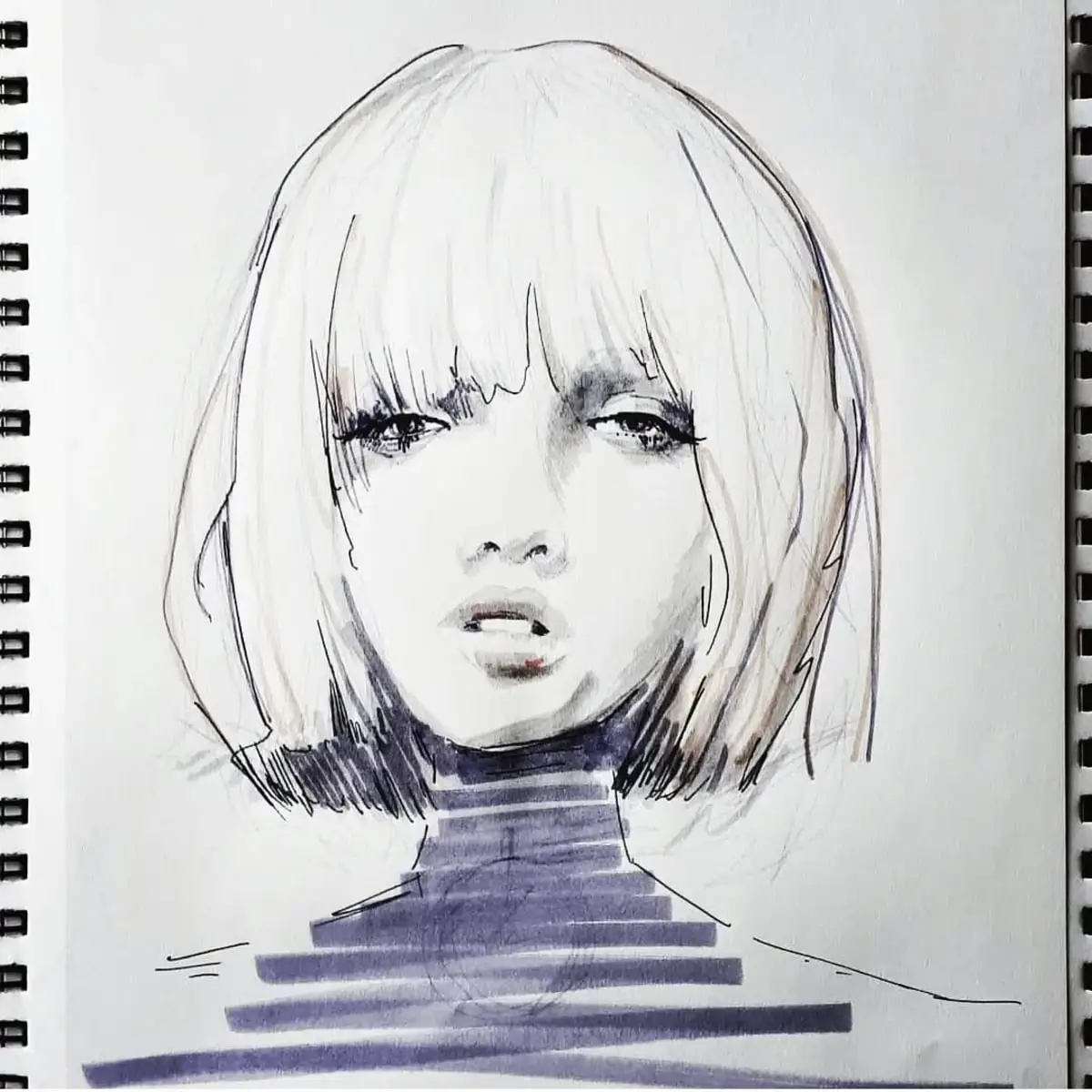
- Your sketchbooks sound quite different from the landscapes people probably associate with you.
- In 2025 you spent three nights at Carlyle Lodge with a group of other artists. What did taking the practice out of your normal environment change?
- Cut Threads became a recognizable thing around Nelson. There was a point where those hats seemed to be everywhere. Why do you think it connected?
- After spending years turning creative ideas into products, did that change your relationship with making things for yourself?
- You've also talked about wanting to take weaving patterns onto buildings.
- Hair seems different from your studio work because another person is immediately involved. Has that changed what creativity feels like?
- You taught a workshop specifically around misty trees. What did teaching something that came naturally to you teach you about your own process?
- Parenthood has also forced some changes in your creative life.
- You almost had a very different creative life. When you were young, you were accepted into the travelling performance group Up with People.
- You've chosen breadth over staying in one discipline. Do you see yourself as a jack of all trades?
- Of all your disciplines, do you consider yourself a master at any?
- Where does hair fit into all this now?
- The Sound — five canvases
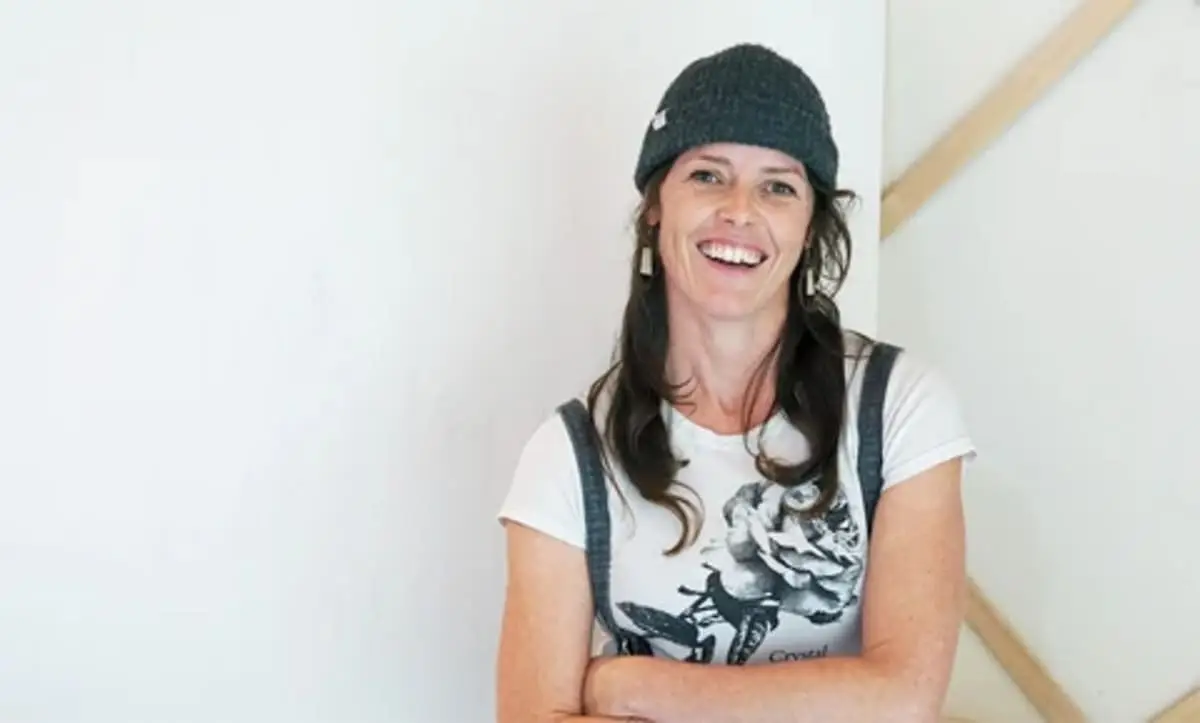
Branda Avis has never had much interest in choosing a single creative lane. Over the years the Nelson-based artist has moved through weaving, apparel, graphic design, illustration, painting, and recently some murals, and more recently still into hairstyling. But underneath those shifts is a consistent impulse: learning how things are made, working with her hands, and finding ways to keep creativity embedded in everyday life.
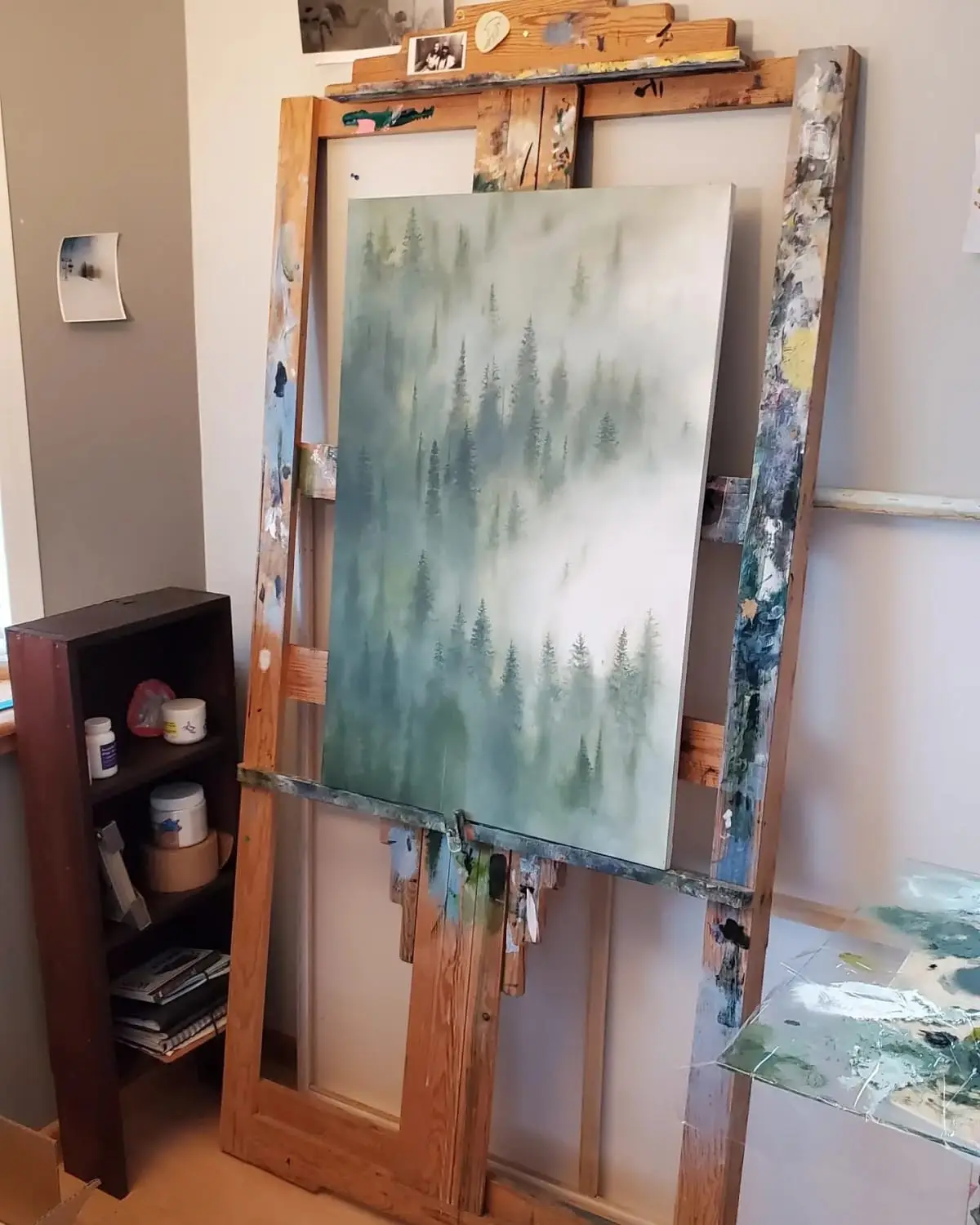
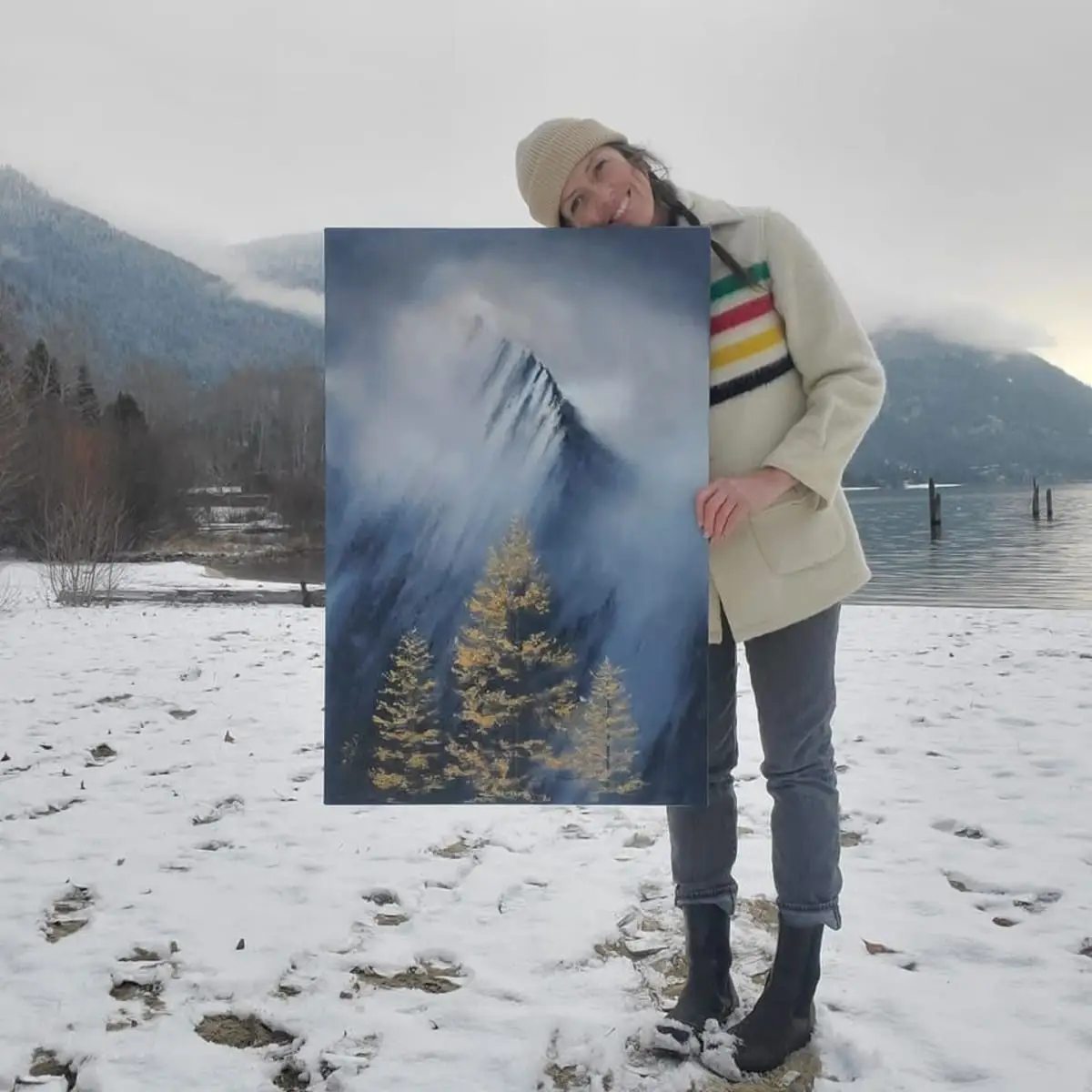
Her best-known paintings are quiet, atmospheric landscapes—mountains disappearing into mist, softened edges, restrained winter palettes. Lately, though, Branda has been pushing against the expectations created by that work, experimenting with flowers, skulls, strange characters, and brighter colours.
We spoke about growing up in Fort Frances, Ontario, the rise of Cut Threads, learning to trust a lifetime of looking at nature, what happens when an artist becomes known for one thing, and why she still prefers being a jack of all trades.
You've worked in weaving, clothing, graphic design, painting, murals, and now hair. Do those feel like different careers to you, or have you basically been doing the same thing with different materials?
They're all very different, I'd say.
Basically for me, it's been: how can I be creative in my workforce? How can I incorporate creativity into a work situation? Everything I've done has been really different, luckily, and that's kept me pretty excited about all the different things.
Painting and illustration are the only things that have always been just my thing that I can't stop doing. I'm borderline, baseline, always obsessed with them and always kind of working on them.
With weaving, I got obsessed with the patterns and the lines that came out of it. I'd never seen anything like it. Then the hats became a way to show off the weaving.
Hair is kind of sculptural. It was always something I wanted to do, but it got sidelined by other things. Even when I was a teenager, people would say, “You should be a florist, or you should do hair,” because there weren't really jobs for artists where I grew up. Hair was always in my head, and it took me until my 40s to actually do it.
Graphics were the same thing. I'd look at something and think, “How do they make a logo where it's only one colour? How is it so crisp?” I didn't understand vector art, so I wanted to learn.
You grew up in Fort Frances, Ontario, and eventually came west through skiing and snowboarding. What did the landscape here do to you visually?
I was pretty enamoured with it, for sure. Mountains—like, wow—and a lake and beaches and all that stuff.
But I grew up on lakes, and I was always studying nature there too. I remember fishing with my dad. My whole family would go fishing almost every night-ish. It was probably less than that, but when you're a kid you remember it as every night.
I would just sit in the boat and look at the water. I'd look at whether it was smooth on top, how it got darker, maybe the stars reflecting in it. It was so dark out there. Or the water would get rough and I'd be like, “Huh, look at the way it is now.”
I was always really studying nature. Always.
Once you get older and you're practised at it, you can kind of go into the catalogue in your own brain. You don't even need a photo anymore.
You're like, “No, it doesn't look like that. It's bluer than that,” or, “This time of day isn't like that. It needs more of this.”
I'd read that mist took hold of your painting around 2019, though that's not how you'd date it yourself. What is it about mist that keeps appearing in the work?
Honestly, I think it's more about a dreamy quality than mist itself.
I like blending the hard lines in my paintings. I like the way that looks, and it brings this dreamy quality. Mist in nature does that too.
I like not seeing a hard line. Lately I've done a bunch where most of them are misted or the edges are blurred. It's definitely turning into my thing, I guess.
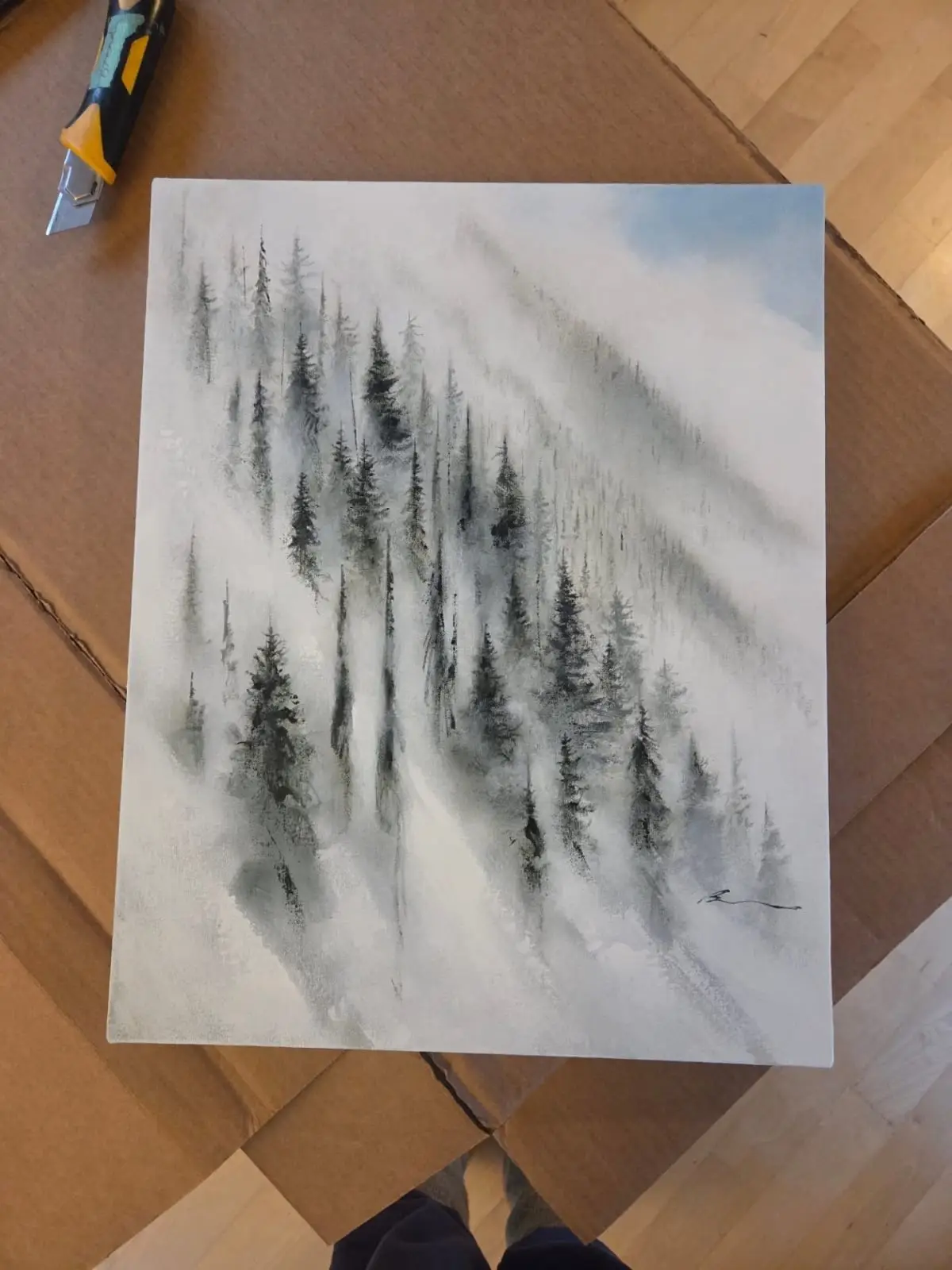
Somebody said about my work years ago that there's a focal point and then the peripheral falls away. I really grabbed onto that idea: okay, the peripheral is going to fade away, but there's always a focal point.
Moving forward, I think I want to go for hardcore realism in part of the painting, and then mist out the edges. There'll be one really real part and the rest will kind of blend off.
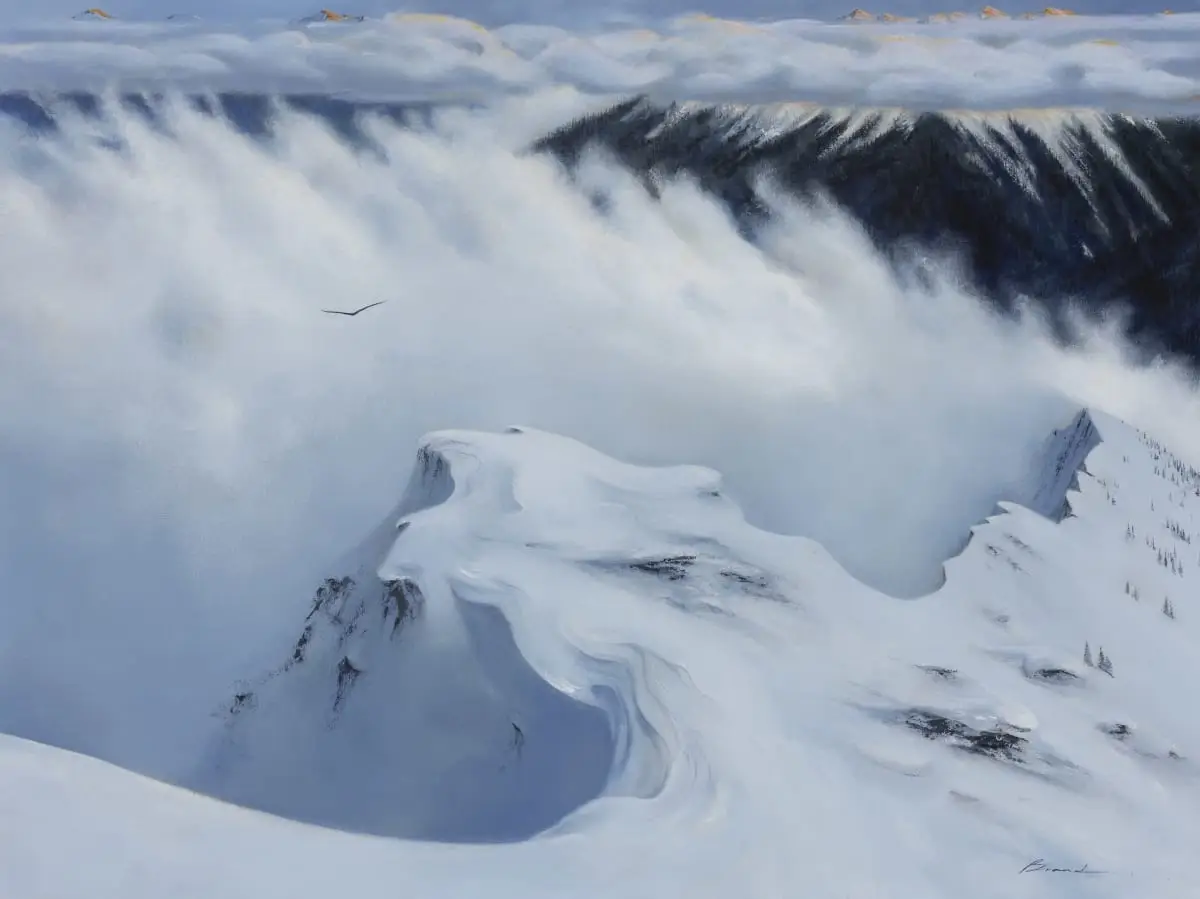
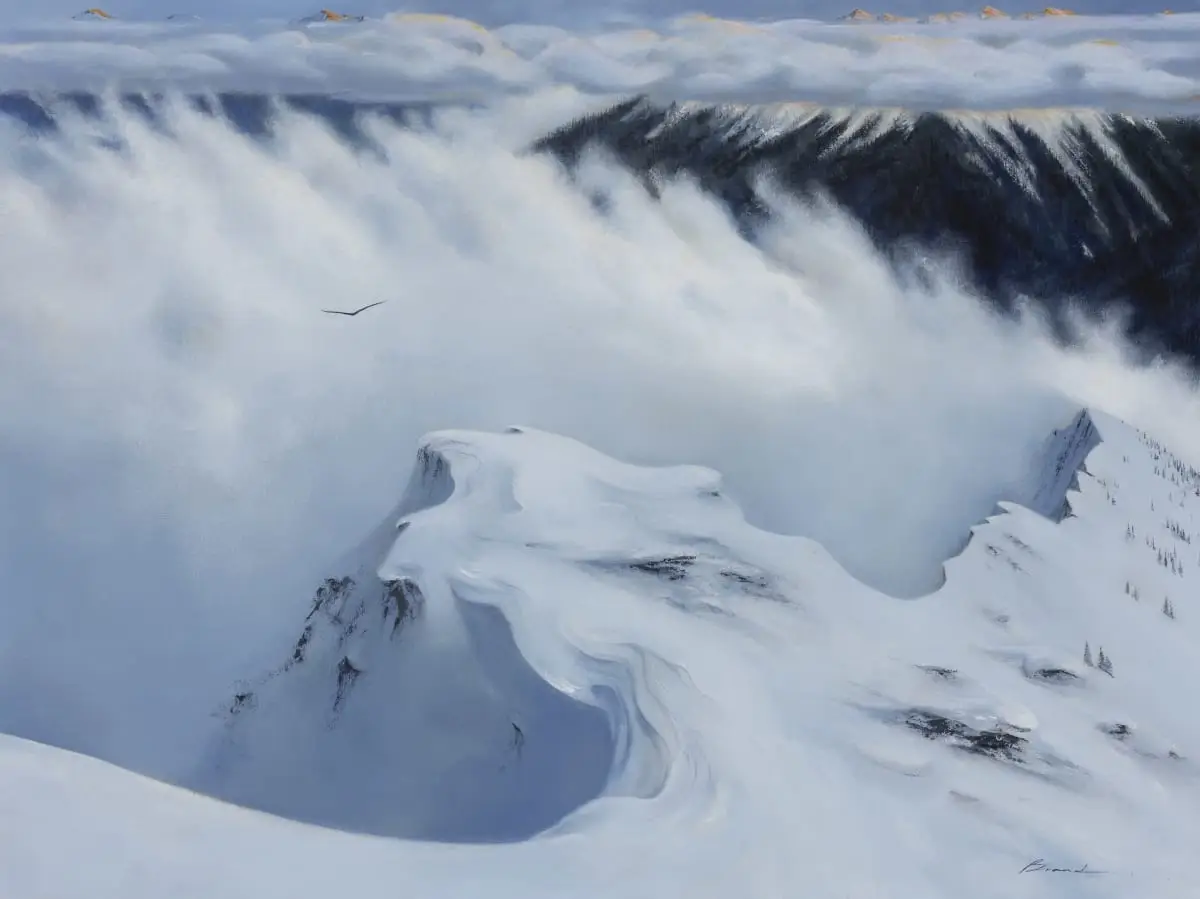
The Sound is interesting because it has that atmospheric quality, but there's also a very defined ridge. You've said that painting was partly a challenge to yourself to try realism.
Yeah. That one was me saying, “I'm gonna actually paint all the way to the edges. I'm gonna paint this image.”
It wasn't as abstracted as some of my other work. It was more like, “I'm gonna go for realism.”
Sometimes I just want to prove to myself that I can do something. It almost becomes competitive within myself.
I called it The Sound because I was like, “You can hear how quiet that is up there in that painting.”
My work is calm. It's quiet. I guess I'm trying to create that feeling of calm with most of it.
With The Sound, I also got to the point where I thought it wasn't finished, so I put some orange alpenglow on the tips. Then I was like, “Okay, now it's done. Sweet.”
You've been known for mountains, trees, mist, and that restrained winter palette. But recently you started making flowers, skulls, and much stranger little figures. What changed?
For a long time I was like, “Oh, I've gotta do mountains,” because I was only doing a couple paintings a year. I was so busy with life, and the trees and mist were being really well received, so I just kept doing them.
Then The Drift Gallery opened on Baker Street and they were like, “We're opening in a month.” And I was like, “Well, shoot, I don't have any paintings.”
I'd also gotten injured at Shambhala, so I couldn't hike or play volleyball. I basically locked myself in my house and painted.
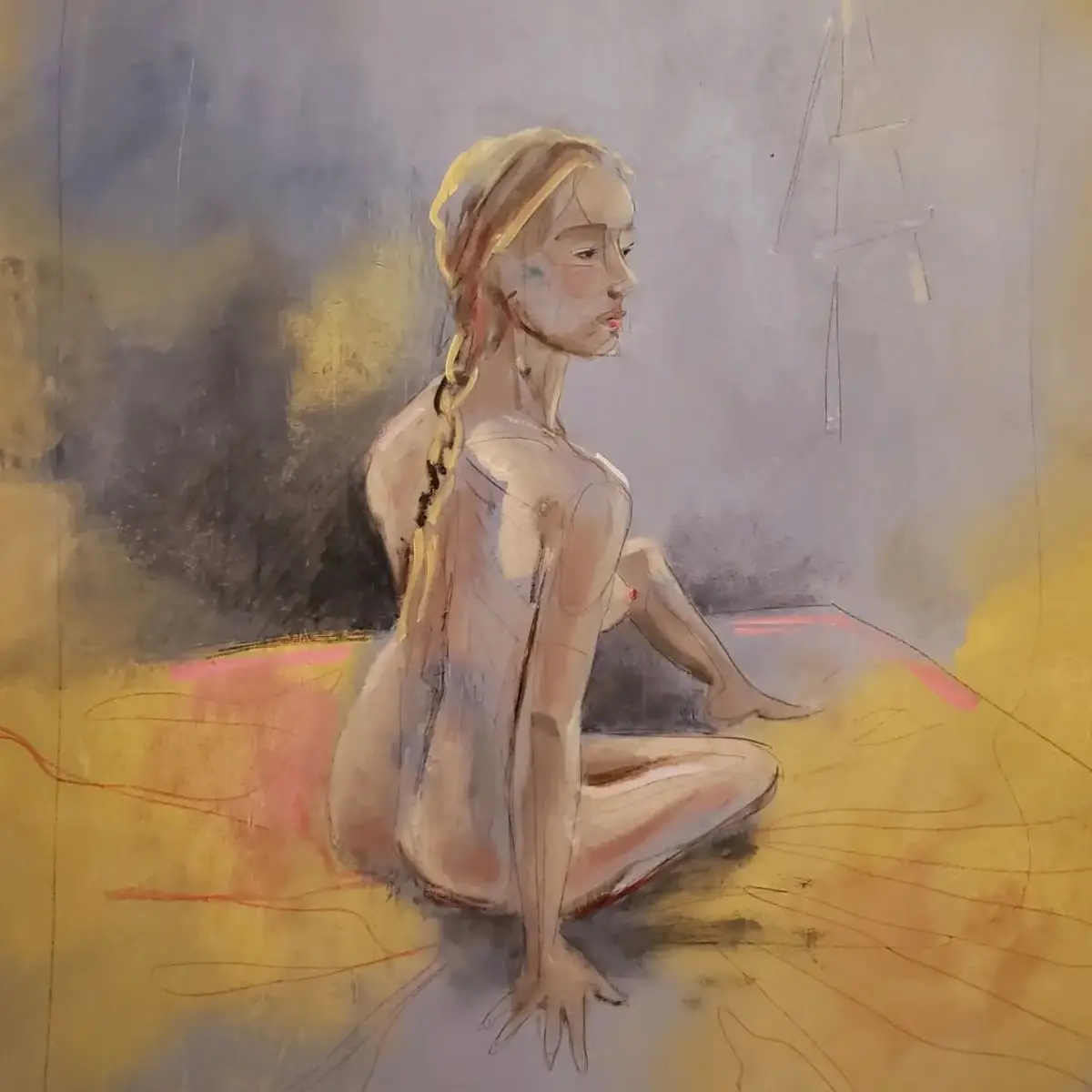
I painted flowers and skulls. It was this juxtaposition of my most feminine self and my most rocker self. And it wasn't for anybody, and it was awesome.
I'd never painted a skull before. I did these little skulls holding food—like, “Oh, I'm a mom, here's this roasted chicken”—and a skull girl in a tutu. They're all these parts of me in these weird little girls.
It was the most refreshing thing I've done in a really long time.
I'm so much faster at drawing and painting now too. I had this realization that I can kind of draw anything my mind wants, a little bit.
The hard part for any artist is that once something works, you can feel beholden to it. I think that's the Achilles heel of every single artist.
You're paid for a certain product. You've gotta deliver it.
Your sketchbooks sound quite different from the landscapes people probably associate with you.
They are. My sketchbooks are pretty dark. Not too dark, but I'm never drawing nature. I'm drawing liney, weird, fun stuff.
I also usually get really artsy late at night. My artsiest time can be from 10 at night until four in the morning. If my kid's with his dad and I have nothing on the agenda tomorrow, I'll think, “Okay, I'm staying up tonight.”
The middle of the night is a really fertile time for artists. There's weird music. Your sexuality comes alive a little more, which isn't necessarily dark, but it's more animal than a daytime person.
I think maybe the darkness lives in the middle of the night.
In 2025 you spent three nights at Carlyle Lodge with a group of other artists. What did taking the practice out of your normal environment change?
It wasn't really a project—it was a getaway retreat that Abby Wilson put together.
We went up for three nights. It was catered, so we didn't have to bring all our food, and everybody brought paint supplies. We painted, hiked, and hung out.
I learned a lot about colour, actually.
One of the biggest things I took away was just tubes of paint I'd never used. Transparent red iron oxide is now one of my favourites. I use it constantly. Mix that with pink and it gives so much life to a colour.
I was asking everyone, “How do you get that sky blue?” or, “Who's got what for yellows?” There are like 17 yellows, right?
I picked up colours I'd never had in my repertoire, and they surprised me with how good they were.
And I made new friends. That was probably one of the highlights of the year.
Cut Threads became a recognizable thing around Nelson. There was a point where those hats seemed to be everywhere. Why do you think it connected?
It was an incredible thing that I was lucky enough to be at the helm of.
Looking back, I don't think there was much out there like it at the time—a ball cap or trucker hat that wasn't branded. There weren't people putting plain fabric or weaving on the front in the same way there are now.
So I think it was genuinely different.
And I was in my late 20s, and I just had fire inside of me. I had so much energy behind it. I was like, “This is what I'm doing. I've got something here. I'm gonna give it my all.”
It was interesting to see that when you put energy in, you get it back.
At that time, that was my baby.
Etsy was new too. A lot of things really lined up.
After spending years turning creative ideas into products, did that change your relationship with making things for yourself?
Definitely.
I still love apparel. I just like cool stuff. If I'd grown up now, I probably would have gone into some kind of surface-design career where I was the person deciding what went on clothing.
But with painting, I've really felt the difference between making what gets received well and making something because I want to make it.
That's why this latest batch was so refreshing. Those paintings weren't for anybody.
With Cut Threads, I also wanted everything to have my hand on it. Drawing made its way into the hats constantly. The bird in the logo—I drew that. Even the inside “Made in Canada” tags had this line I worked on forever in vector. I'd undo it and redraw it over and over trying to get the right line.
I wanted everything to have my hand on it.
You've also talked about wanting to take weaving patterns onto buildings.
Yeah. I'd love to do weaving patterns as murals.
Weaving is basically a grid, and you fill it in however you want. Even a checker pattern is a plain weave: one over one.
That would be really cool to scale onto a building.
I want to be a mural artist. I've done a few smaller things, but I haven't really had the opportunity to do that in town yet.
It'll happen.
Hair seems different from your studio work because another person is immediately involved. Has that changed what creativity feels like?
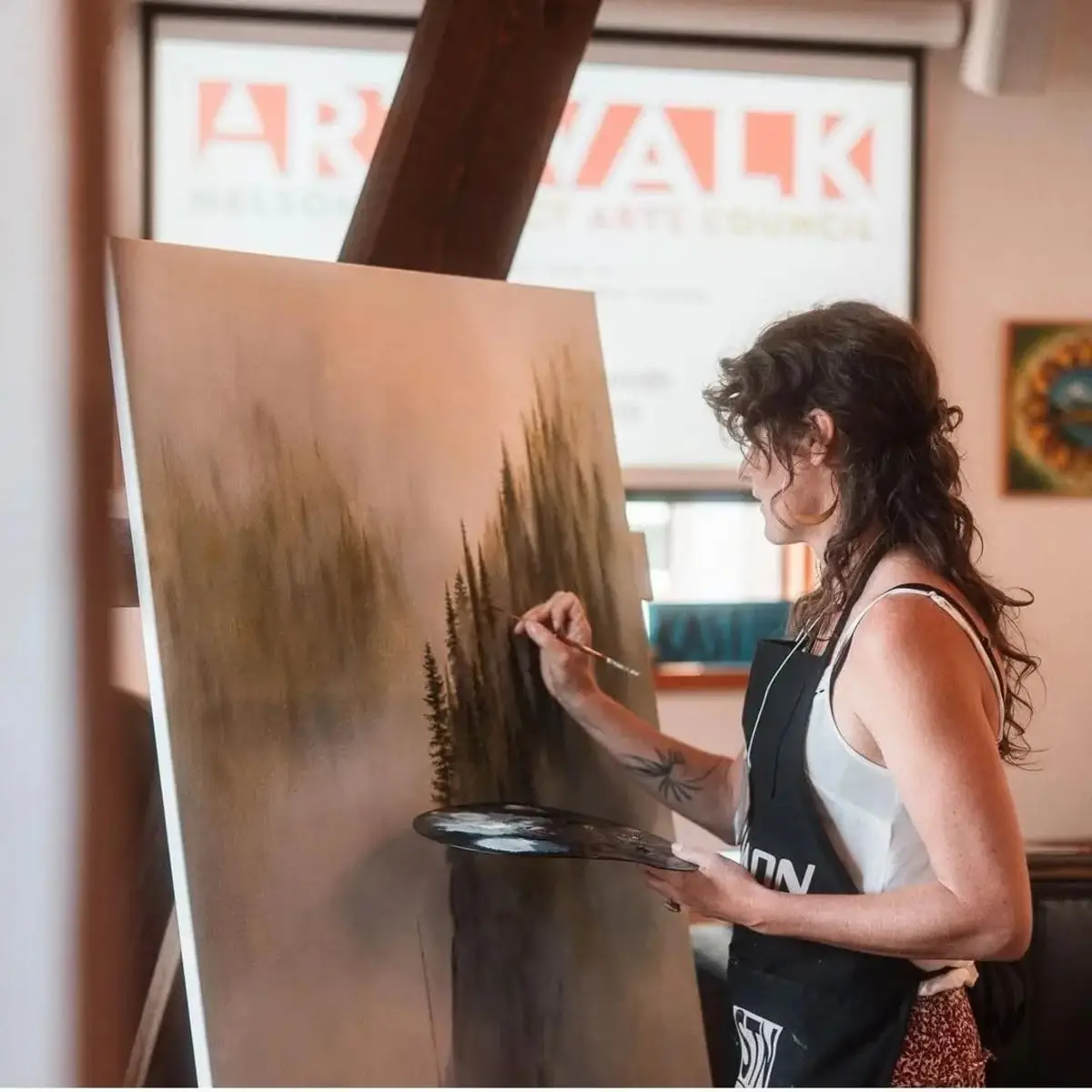
Hair is really social.
All the other stuff is like: you're alone in a studio. With hair, you've got that social vibe. You're chatting. You become part of people's lives. One guy comes in every three weeks. You get to know people.
You're in the community instead of being that solo art girl.
It's also different because it isn't about me. If somebody comes in and says, “I want bangs,” I'm like, “Let's go.” You want to cut all your hair off? Sure. I'll tell you, “Brace yourself, this is a big change,” but I'm not going to talk you out of something you've already decided.
And it's tactile. I need to use my hands. I'm very good at creative things with my hands.
That was a big part of choosing hair.
You taught a workshop specifically around misty trees. What did teaching something that came naturally to you teach you about your own process?
The first thing I learned was that I'd skipped a step.
I went in thinking, “Okay, we're going to paint misty trees,” and then realized, “Oh, none of you guys actually know how to draw a tree. Okay, let's back up.”
It made me realize how much you take for granted when you already know how to do something.
If I did it again, I'd probably structure it over several shorter sessions instead of one big one. First: how are we at drawing trees? Somebody might already be an artist. Somebody else might say, “This said beginners and I've never done this.”
You need to make sure everybody can at least get a shape onto the canvas that looks good enough for them to play with.
Drawing is painting, just using a paintbrush, really.
Parenthood has also forced some changes in your creative life.
Yeah. There was definitely a period where everything went on pause.
But you're never going to get that time back. Your job is mom first or dad first, and what a gift that is. That's a whole other creative thing.
How do you have fun with your child and help shape them into whatever they want to do?
It's not about you anymore when you have a kid.
It is, but it isn't.
You almost had a very different creative life. When you were young, you were accepted into the travelling performance group Up with People.
Yeah. I was pretty out there as a kid.
I had short goth hair, I worked at Dairy Queen, and I was jacked on life. I did not fit the mold of my hometown at all, and I was gonna bust out hard.
Up with People used to come through Fort Frances when I was a kid. These people from around the world would stay with families in town. I thought they were so cool.
I remember one woman had these Gwen Stefani punk pants. In my eyes, she was the absolute coolest. I wore her plaid pants to school.
There was nothing like that where I lived. The closest Hot Topic was in Duluth, Minnesota. I wanted to be a skateboarder so badly. I knew all this other stuff existed in the world, but I couldn't access any of it.
My parents encouraged me to audition for Up with People. I could really sing when I was young, so I auditioned and got in.
I worked two jobs through high school and saved all this money to go.
Then it went bankrupt.
Suddenly it was, “Now what?”
I ended up travelling to Australia, and then because I had this skiing background, I moved west and became a ski bum. That was fun for a while, but there was this art thing brewing underneath the surface.
There was always a big “What am I doing with my life?” happening underneath.
That was the fork in the road for sure.
You've chosen breadth over staying in one discipline. Do you see yourself as a jack of all trades?
Yeah. I like being a jack of all trades.
I know software. I can sew. I can cut hair. I've done sandblasting. I've made trophies. I understand how things are made.
I remember realizing with the hats, “Oh, I can get these made in China. Sweet. I'll figure that out.” At the time, figuring out manufacturing like that felt like a huge deal.
I'm a little bit on a mission to be very skilled in things that don't pay.
But I like being skilled. I think it's good to have a vast set of abilities.
Of all your disciplines, do you consider yourself a master at any?
I'd give myself “master illustrator” now. I can draw anything, and that can become a painting.
But I still like testing that.
The Sound was me asking, “Can I do realism? Let's see it.”
Then I did it and thought, “Yep, I can.”
There are still challenges I haven't tried. I haven't painted some huge building perfectly enough that it looks like a photograph. That would be a good test.
But there are also things I couldn't necessarily do honestly. A tropical landscape, for example—I haven't studied that landscape the way I've studied Canada.
I know what a cedar tree looks like during the day. I know what it looks like at night. I know what it looks like as a silhouette.
I don't know what a palm tree looks like.
Where does hair fit into all this now?
Hair pays the bills, and that's something renewable. AI can't take it away.
Graphic design was supposed to be my fallback. But then it started feeling like, “Okay, now I've got to learn AI if I'm going to get these graphic design jobs.” And I thought, “Well, no, I don't want to do that.”
Hair is tactile. It uses my hands. I can do it from my basement if I need to. If everything hits the fan, people are still gonna need haircuts.
I don't think I'm going to become some serious master of hair. With my age, where I live, having a kid and all my other pursuits, I'm probably not going to Vancouver to do everything it would take to become that.
But once I understand it a little more, I think it'll be on.
There are techniques like balayage where you're literally painting bleach onto somebody's hair.
That crossover makes a lot of sense to me.
The September edition
The Sound — five canvases
Printed in Winlaw and stretched by hand over cedar bars milled here from local 2x6 stock. Each one is signed and numbered by Branda. The edition is closed at five and will never be reprinted.
5/5 is being given away. Free to enter, drawn by hand at The Sandbox on September 22. The other four are for sale — delivered in person anywhere in the Nelson–Castlegar–Slocan corridor, shipped anywhere else in Canada.
- Edition
- 5, never reprinted
- Size
- 24 × 18 in
- Price
- $250 CAD
- Draw closes
- September 22, 11:59pm
Questions about Branda Avis
What is Branda Avis known for?
Branda Avis is known for atmospheric landscapes with mountains, mist, softened edges and restrained winter palettes. Her creative work also includes weaving, apparel, illustration and hairstyling.
What is The Sound by Branda Avis?
The Sound is the mountain landscape behind WinPrint’s September 2026 canvas edition. Avis describes its atmosphere as quiet and calm, with orange alpenglow on the mountain tips.
Find the artist
Branda Avis’s website · @branda.avis.art on Instagram · Branda Avis’s WinPrint artist profile
Explore the current Artist Series
WinPrint’s Artist Series produces signed, numbered canvas editions of five. One canvas from each edition is offered through a free public draw.
See the current drawExplore this artist’s collection