Andreas Tiedemann: Graffiti Without Words
Andreas Tiedemann is an artist whose practice connects graffiti, live painting and festival culture. In this interview, he discusses the Village at Shambhala, his recurring robots and Break of Dawn.
In this interview
- Your mom was one of the first people who got you into art. What did that look like when you were a kid?
- This was Calgary in the mid-'90s, before you could pull up thousands of graffiti images online. How were you learning?
- An art teacher you had in high school told you graffiti wasn't art because you sketched something first and then reproduced it.
- How much control do you actually want over a painting?
- You don't seem interested in endlessly polishing one painting either.
- What happens to your work when you have to finish something in a place full of people in a few hours?
- You were involved in Shambhala very early. How did you go from attending the festival to helping build the Village?
- WHRS came out of a different corner of graffiti culture than most people picture.
- Shambhala also seems to have functioned as an engine for the whole scene.
- We've talked a lot about the abstract work, but then there are your robots. They've been following you for more than twenty years. Where did they come from?
- Do you think of the robots and something like Break of Dawn as part of the same world?
- Looking at the abstract work, the brushstroke itself feels like part of the subject.
- You've gone from being told spray paint wasn't a serious medium to having people tell you they've followed your work for years. Does that kind of recognition ever become normal?
- Break of Dawn — five numbered canvases
Andreas Tiedemann's work carries several histories at once: comic books, graffiti, rave culture, live painting, the Village at Shambhala, improvised materials, and decades of learning what happens when you make a mark and refuse to erase it.
He emerged from Calgary's punk and graffiti scenes, and through those roots he found rave culture. He was one of the artists who built the early look of the Village at Shambhala — arriving before the gates opened with a milk crate of spray paint and no budget, and staying for years.
His paintings can be dense and organic, built from splatters and sweeping brushstrokes that seem to grow into strange ecosystems. Elsewhere, his long-running robots — his "Paranoid Androids" — remain unmistakably his, even after periods when he tried to leave them behind.
We talked about learning to paint with his mother, discovering graffiti in Calgary in the 1990s, the difference between controlling a painting and responding to one, and why sometimes the best thing an artist can do is finish the piece and make another.
Your mom was one of the first people who got you into art. What did that look like when you were a kid?
My mother was very influential. She always encouraged me to do art. We would sit down and paint and draw together.
By trade, in Switzerland, she was a nurse, but she was always very talented artistically. She still does watercolours today. I actually keep all that stuff. Anything artistic from my family — my mom, my sister — I keep it.
She would make things like a painted name tag for my bedroom door, stuff like that. She was definitely the person who originally showed me how to use a brush. Art was a method of bonding for us. We always had craft time.
I drew all kinds of stuff as a kid. GI Joe, Star Wars, dinosaurs, He-Man. I went through a huge Bart Simpson phase. My cousin was really into drawing comics and taught me more about using pencils, and then I became obsessed with Todd McFarlane and Spawn. That Image Comics look, the way those books were drawn and coloured — I loved all of that.
Then around grade six, a German kid from Berlin came to our school. I was the only kid who spoke German, so naturally we became friends. He asked me, "Do you tag?"
I had no idea what that meant. He basically explained: you make up a name, and then you write it everywhere.
I was like, "That's brilliant. Sign me up."
After that, graffiti just took over. I forgot about comic books. I was learning guitar and drums — forgot about that. Video games, whatever. Nothing else mattered. I just became obsessed with drawing letters and graffiti.
This was Calgary in the mid-'90s, before you could pull up thousands of graffiti images online. How were you learning?
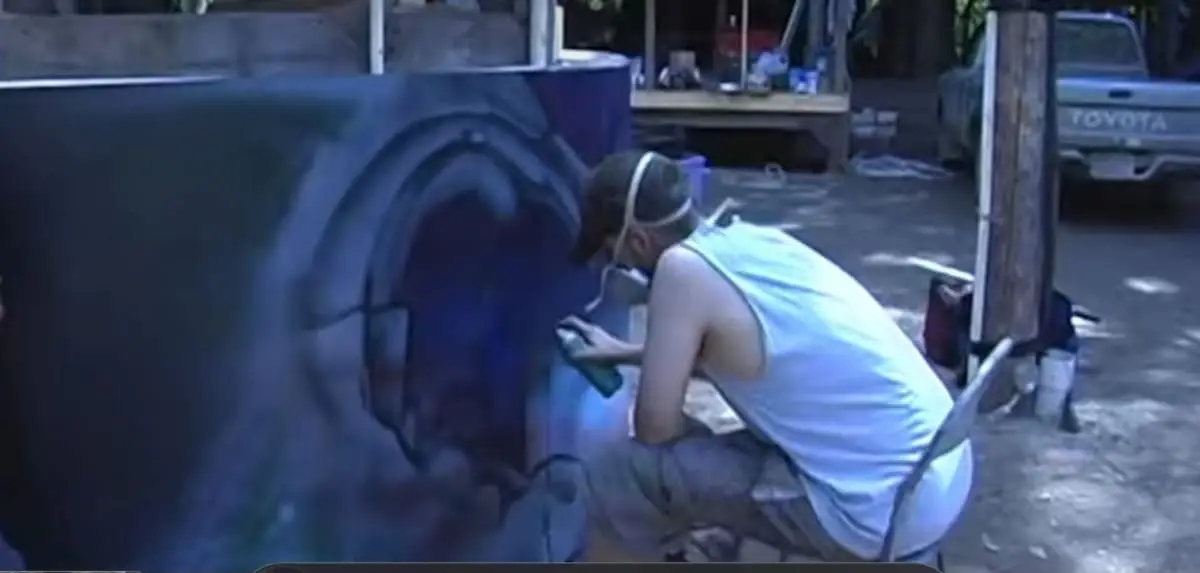
The Source magazine had a graffiti section in the back, so I would look at that. If there was a newspaper article about graffiti, I'd cut out the pictures and save them.
Behind a 7-Eleven in my neighbourhood there was this piece that said LINC, and it kept getting bigger and getting worked on. I would go behind the 7-Eleven all the time just to see what had changed.
It turned out the person painting it was Pesto, who is now one of my best friends.
Then one of my friends finally got the internet and we found Artcrimes.org. It was this really simple website where you could look at graffiti by city, country, letter — and suddenly you could see graffiti from everywhere. I remember being completely blown away by it.
And now I'm actually on Art Crimes, which is pretty funny. Something that showed me the scene in the first place eventually had my work on it.
My family also took a trip to Vancouver around that time. We stayed around East Van, and I was in heaven. My parents were terrified, but I was in heaven.
We went to Beat Street and I bought two graffiti magazines. One was Xylene, this really DIY graffiti magazine, and another was from Spain. I basically spent my entire trip allowance on two magazines. My parents couldn't believe I was spending that much money on magazines.
I still have them. They're falling apart, but I still have them.
In graffiti we call those old physical photos and magazines "hard copies." Getting the photo after you painted something was a huge part of it too. You wanted that hard copy.
An art teacher you had in high school told you graffiti wasn't art because you sketched something first and then reproduced it.
Yeah. That teacher was actually very encouraging to me in other ways. There was an old black-and-white photo lab at the school that wasn't really being used, and I asked if I could get it going again. She let me do that, so I set up the photo lab and basically taught myself how to develop black-and-white photos.
But she said graffiti wasn't really art because you draw it first and then you go paint what you drew.
And I remember thinking, okay, then I won't use a sketch. That stuck with me.
Every time I try to use a sketch now, the finished thing doesn't really look like the sketch anyway.
There's something about spontaneity and flow state that became really important to me. Think about someone playing a guitar solo. There's something happening right there in the moment that wasn't completely predetermined. That became a big part of how I paint.
At ACAD there was also this attitude at the time that spray paint wasn't really a viable art medium. This was before Banksy became what Banksy became. And graffiti itself was already kind of anti-art-school. It still is, in a way.
I just didn't really vibe with the whole art-school environment. I thought I was going there to learn how to use a brush. It wasn't really what I expected.
How much control do you actually want over a painting?
I like randomness.
If I'm dripping paint onto a canvas, I can decide I'm going to drip black in this corner, but I don't really decide exactly where every drip goes. A lot of times I don't know what to paint, so I'll start throwing paint at the canvas and let that give me the direction.
I've graduated to the point where I have more of an idea of the colours and composition I'm going toward, but there's still a lot of randomness. Lots of happy mistakes. I watched a lot of Bob Ross too.
A big thing for me is that there are no erasers with paint. If I make a mark, it's there. So now what? How do I make it work?
I also worked in paint stores for years, and that had a huge influence on me. I would work on a painting for hours, then look down at the drop sheet and think the drop sheet looked cooler than the painting. All those accidental layers of paint and splatters and textures — that became part of what I was interested in.
I still use a lot of house paint. I save old paint forever. I'll go into my stash and say, okay, this is what I've got. Now make it work.
If you take me into a paint store and tell me I can have any colour I want, I hate that. Give me five colours that don't really make sense together and the challenge becomes figuring out how to make them work.
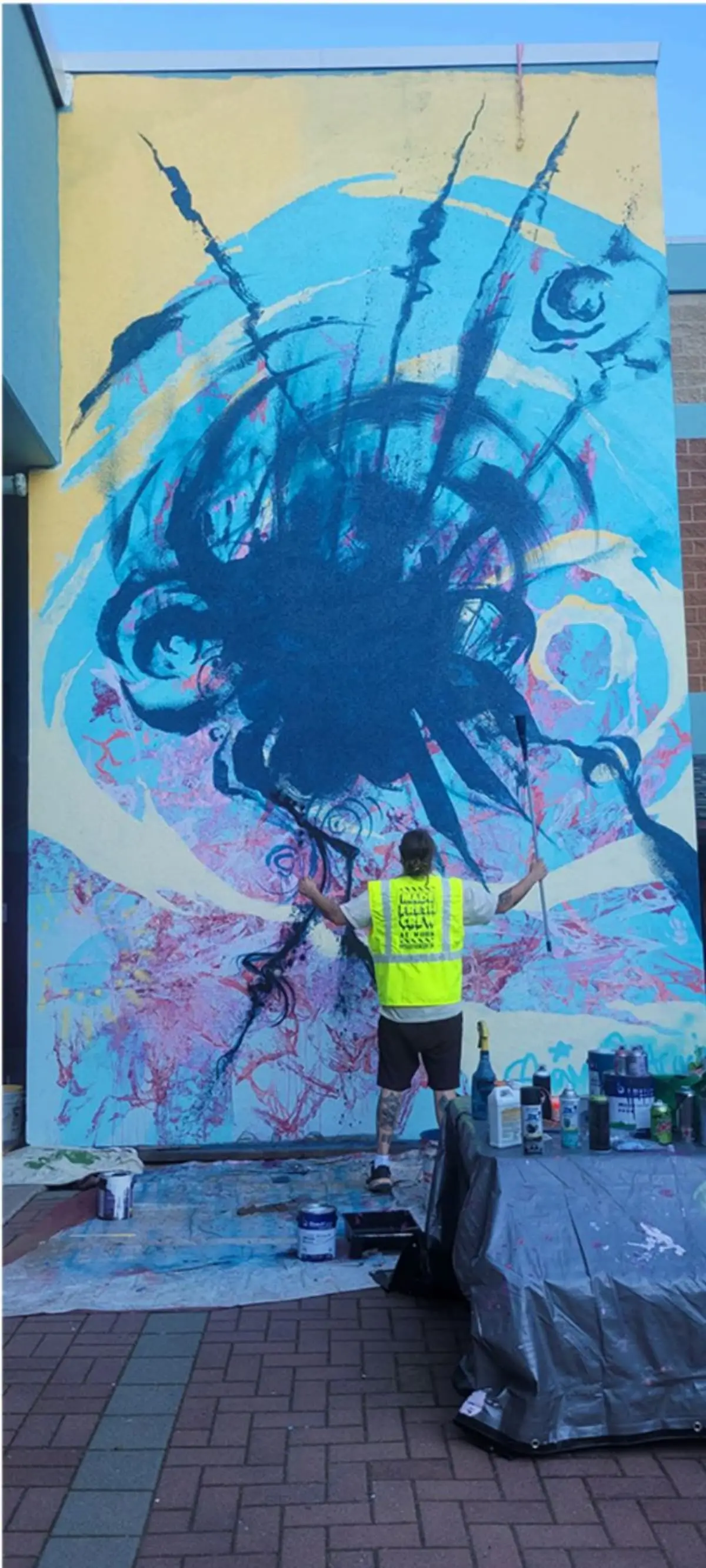
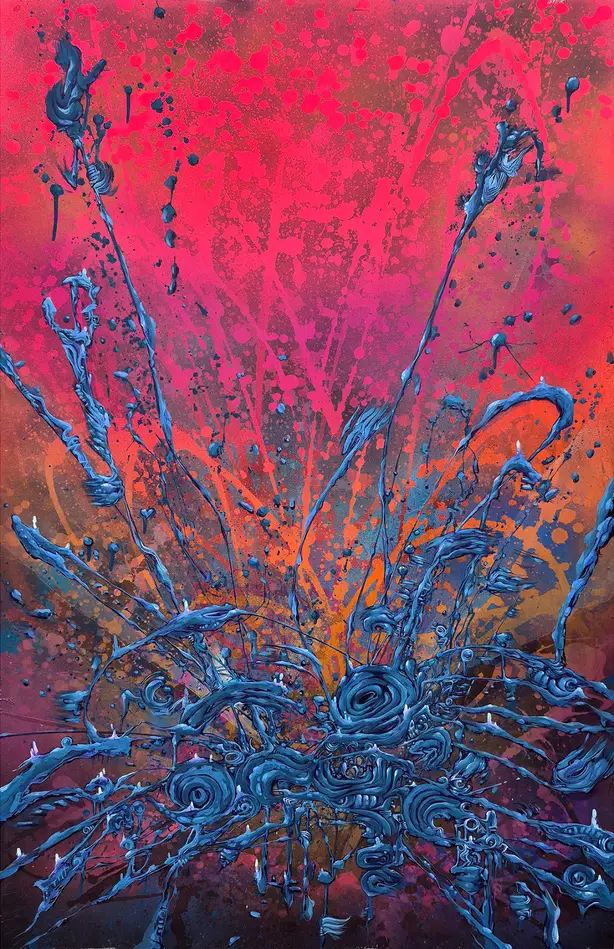
With Break of Dawn, people sometimes look at the forms and say, "Is that a motorcycle?" or "Is that this thing?"
No. I'm just looking for a composition and a flow that works.
I sometimes think of it as graffiti without words.
You don't seem interested in endlessly polishing one painting either.
No. I rarely paint just one thing at a time.
I'll start two or three paintings, sometimes more. Eventually I'll get frustrated with one or I won't know where it's going, so I put it away. I'll hide it on a shelf in the studio or garage and start something completely different. Then I might end up with six or seven half-finished paintings.
When I come back to one later, suddenly whatever problem I had with it is obvious. You come back with a clear head and think, "Oh, I got it."
Very rarely do I think something is completely beyond saving. And if I'm really stuck, I think you're usually better off making another thing than beating one piece to death.
I met ill.Gates years ago at the village, and one of the things that stuck with me was this idea that at some point you just finish the track and make another one.
I tell younger artists that now too. If you're completely stuck on one thing, sometimes you just have to let it go and make another one.
What happens to your work when you have to finish something in a place full of people in a few hours?
Graffiti already teaches you that you don't have a week. You have whatever amount of time you have.
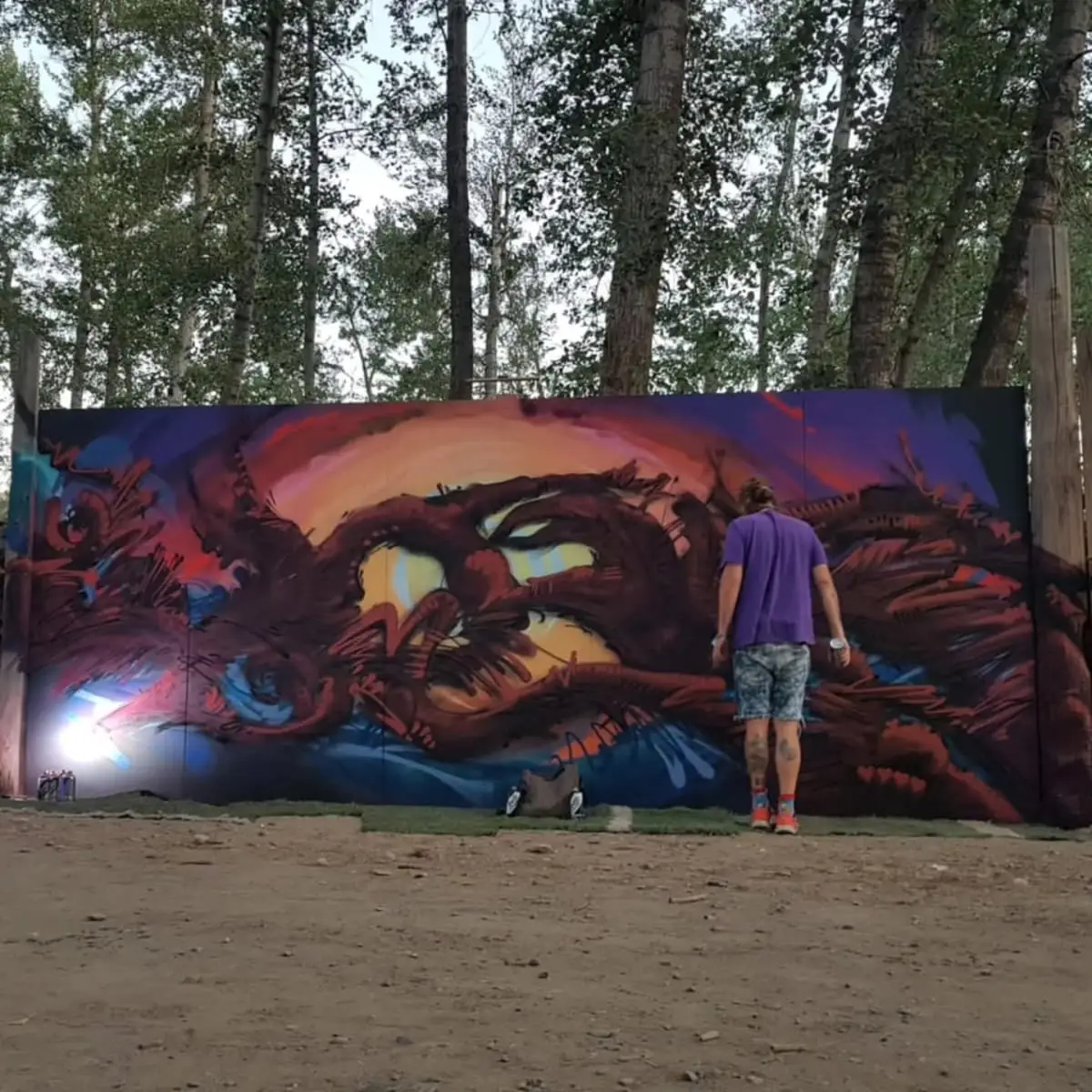
I took that into live painting. I felt like I had to basically finish the painting that night. Maybe I'd do some finishing touches later, but a lot of them were made in five hours or whatever the event gave me. That influenced the way I paint.
You're painting in a dark room, so you start thinking about contrast and whether people can actually see what you're doing. Your brushwork gets faster. You stop sweating every mistake. Something doesn't look perfect? Who cares. Keep going.
That actually built a lot of confidence.
Break of Dawn is interesting because I originally started it as a live painting at BassCoast, but it sat unfinished for quite a while afterward.
Eventually I started thinking: you've proven you can fire off a painting in one evening. What happens if you take that same confidence and give the painting a month?
That has been more of what I've been working on in the last couple of years — slowing down, working on my brush skills, taking my time and owning the craft without losing that spontaneity.
You were involved in Shambhala very early. How did you go from attending the festival to helping build the Village?
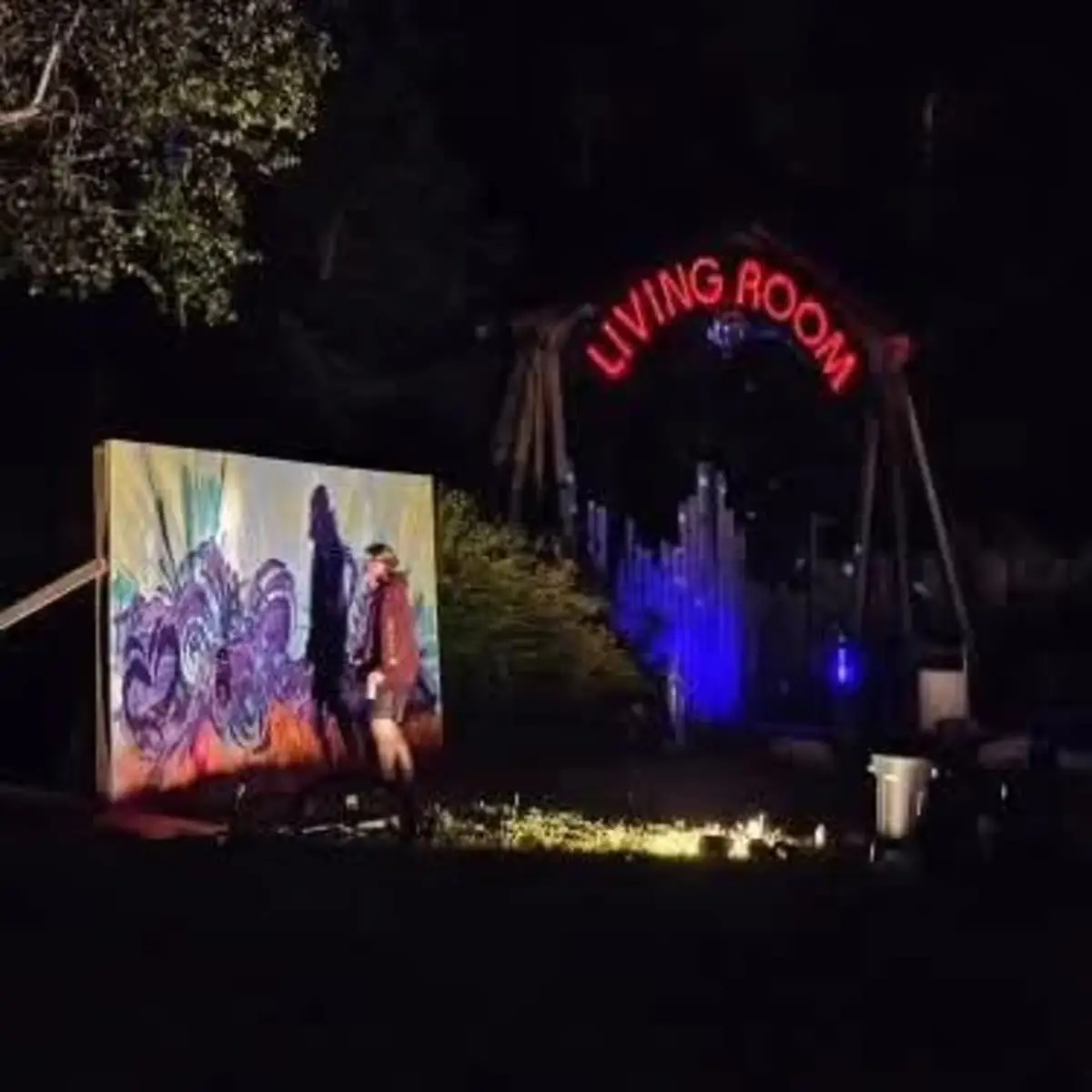
Through graffiti I had already started painting at raves and making flyers and banners. Around 2000 I met Fat Pat, Benny B-Side, John Bichel and those guys, and I started learning more about jungle, breaks and that whole scene.
I wanted to go to Shambhala in 2001 but couldn't get the time off work. Eventually I did go. The ticket was something like eighty bucks, which was about half my paycheque at the time. It blew my mind.
And afterward I remember thinking: I'm not coming back here unless I'm involved. I didn't want to just show up and party. I wanted to do something.
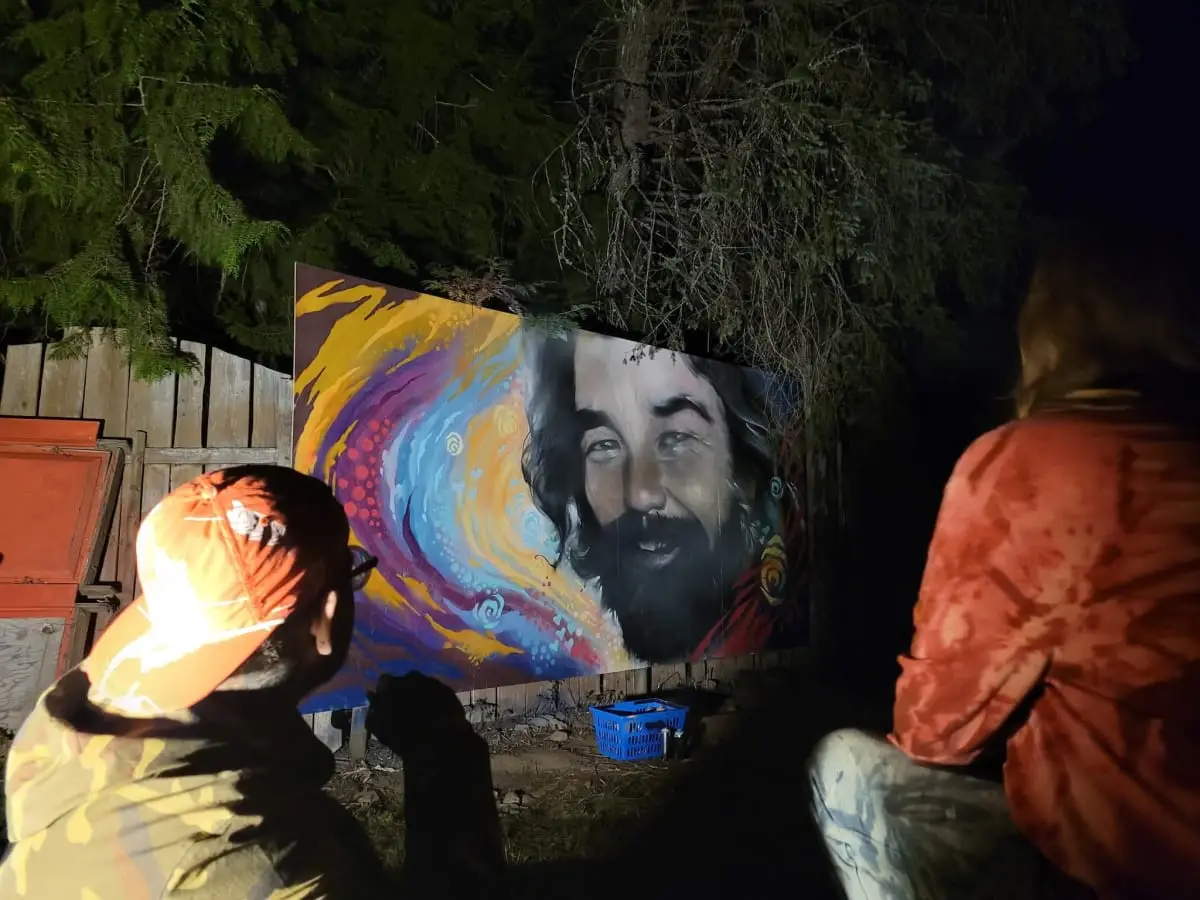
So the next time I came out early. I had my backpack, my tent, a milk crate with maybe twelve cans of spray paint, some brushes and whatever paint I could carry. That was when the Village still had the rotating stage.
There's actually an old photo online now of me painting that stage, which is funny because I don't even have the original photo myself.
At first I was basically just the dude who showed up to paint trippy shit. Then I brought Pesto out.
Those early years were very DIY. We had no budget. We would find scrap materials and build things out of whatever was available. The Village sign was made with different pieces of scrap wood that we had to go find.
That was the magic of it: we could basically do whatever we wanted. We just had to figure out how to make it. It was like Lord of the Flies or Goonies.
WHRS came out of a different corner of graffiti culture than most people picture.
We were more from the punk-rock side of things.
A lot of graffiti culture was very hip-hop oriented, and obviously we were influenced by that too, but we were also coming from the all-ages punk scene and this more DIY mentality. We were kind of anti-hip-hop within a scene that was already outsider culture.
That DIY part definitely stayed with me. And Shambhala gave us this giant place where we could explore that creativity. We brought a bunch of people in, went crazy making stuff and helped develop that early Village aesthetic.
You don't have a power drill? You don't have that material? Fine. Figure it out.
Shambhala was a boot camp for that whole way of working. Seeing where it has gone now is pretty wild.
Shambhala also seems to have functioned as an engine for the whole scene.
Benny B-Side said something to me years ago that always stuck with me: "Get in where you fit in."
The rave scene was really good for that. You paint? Cool. Paint. You make string art? Cool. Make string art.
There wasn't this authority saying your medium didn't count. That meant a lot after being told things like spray paint wasn't viable.
And a lot of the artists from those early Shambhala years ended up inspiring younger people to go there. Kids saw that place and thought, "What is this?" Then their goal becomes: I want to paint at Shambhala. And once they do that, maybe they go somewhere else.
It's the same with DJs. Someone's goal is to play the Rabbit Hole, or play on PK, and then they go from there. Shambhala is a huge community builder.
We've talked a lot about the abstract work, but then there are your robots. They've been following you for more than twenty years. Where did they come from?
They started around my ACAD years, around 1998 or 1999. We had some school project and I drew this character with the big eyes. It still had some of that Todd McFarlane sketchiness in it. Then I just kept drawing them.
Eventually I started painting them, and they became my Paranoid Androids — obviously the Radiohead reference.
People ask if the main robot has a name. I call him Lactose. Because he lacks toes. They often don't have feet.
I painted them in graffiti, painted them at Shambhala, and eventually they became a thing people recognized.
Then I got sick of them. I wanted to challenge myself and do something else, so for a while I stopped painting them.
But people kept asking about them. Eventually I tried them again and realized, oh — I actually enjoy doing this. Now it would almost be weird if I never painted them again.
Do you think of the robots and something like Break of Dawn as part of the same world?
No. In my head they're separate.
Break of Dawn and those kinds of paintings are more what I think of as my fine-art work, or whatever you want to call it. Those paintings are like worlds.
I take influence from coral reefs, jellyfish, mossy rocks, the ocean — all these organic things that are weird and don't totally make sense.
The robots are more like my comic-book character. I wouldn't normally make one of those intricate abstract paintings and then stick a robot in the middle of it. They don't really cross-pollinate.
With the abstracts, I'm trying to convey emotion and movement through the brushstroke and the composition. With the robots, their hands are always doing something. There's movement and expression there too, but it's a different language.
They're kind of my Bart Simpson. At this point I know how to draw them. They're just one of the things I do.
Looking at the abstract work, the brushstroke itself feels like part of the subject.
Definitely. Live painting and painting to music had a huge influence on that. There's an element of dancing with the brush.
That's part of why I like painting fast and why I like working in the moment. You can see that movement afterward. The brushstroke records some kind of emotion or feeling from when it happened. Music is a huge influence on that.
I admire pinstripers for the same reason. Someone lays down this line and that's the line. There's no erasing it.
Maybe it wobbles a little. Okay. Work with the wobble.
I'm basically self-taught with a brush other than the basics my mom showed me when I was a kid. I don't even know if I paint with a brush the way you're "supposed" to paint with a brush. It's just how I do it.
I like the one-liner feeling — commit to the movement and see where it takes you.
You've gone from being told spray paint wasn't a serious medium to having people tell you they've followed your work for years. Does that kind of recognition ever become normal?
I don't know if I'll ever totally get used to people telling me they love my art. There's probably some imposter syndrome in there.
For years you hear all this stuff: artists don't make money, graffiti isn't art, spray paint isn't viable.
Then suddenly people are telling you that something you made actually means something to them. And part of you is still going, really?
But I've had to learn to accept that if somebody wants to live with a painting and look at it every day, then they really do connect with it.
That's a strange feeling.
It's like somebody heard me screaming.
The Edition
Break of Dawn — five numbered canvases
A hot magenta field shot through with splatter, and rising into it from the bottom edge a dense tangle of blue-grey coils and spines — part coral, part wreckage — lit from behind by a band of orange. Started as a live painting at Bass Coast, finished slowly, years later.
One of the five is being given away. The other four are for sale, printed and hand-stretched on cedar bars in Winlaw.
- Edition
- 5 numbered canvases
- Given away
- 5 of 5, by draw
- Price
- $250 CAD
- Draw closes
- August 22, 2026
Questions about Andreas Tiedemann
What influences Andreas Tiedemann’s art?
Tiedemann describes a practice shaped by comic books, Calgary’s punk and graffiti scenes, rave culture and live painting.
What is Break of Dawn by Andreas Tiedemann?
Break of Dawn is the artwork behind his August 2026 WinPrint edition. It began as a live painting at Bass Coast and was finished years later.
Find the artist
Andreas Tiedemann’s website · @fiftyshadesofdre2026 on Instagram · Andreas Tiedemann’s WinPrint artist profile
Explore the current Artist Series
WinPrint’s Artist Series produces signed, numbered canvas editions of five. One canvas from each edition is offered through a free public draw.
See the current drawExplore this artist’s collection